Welcome to the US Culture of Excellence Website
Our Vision
Introduction: The Architecture of Vision
Every human life is built around a vision—whether consciously shaped or unconsciously inherited. This book begins with a simple but radical premise: our vision determines our trajectory. It governs how we interpret experience, how we respond to challenge, and ultimately how we evolve. Yet most people move through life with only fragments of a vision, pieces that never cohere into a guiding architecture. What we need is a vision capable of holding the full complexity of human development.
The first layer is personal vision—the inner picture of who we are and who we are becoming. Personal vision is not a fantasy or a wish; it is a disciplined orientation toward growth. It is the internal compass that allows a person to navigate uncertainty without losing themselves. When personal vision is weak, life becomes reactive. When it is strong, life becomes intentional. The personal vision is an internal mental construct of the mind.
But personal vision alone is insufficient. To grow, we must also cultivate a vision of reality—a clear, unflinching understanding of the world as it actually is. Reality is not always kind, and it is never simple. It contains forces, systems, and patterns that shape human behavior long before we are aware of them. A vision of reality demands intellectual honesty, emotional courage, and the willingness to confront complexity without retreating into illusion. Without this vision, personal vision collapses into naïveté. Although the vision of reality is about our external world, it is also a mental construct of the mind.
The highest form of human development emerges only when these two visions are fused. This is integrated vision: the capacity to see oneself and the world simultaneously, without distortion, and to act from that synthesis. Integrated vision is the foundation of maturity. It is the architecture through which individuals become capable of excellence, leadership, and meaningful contribution. It is the vision that allows a person not merely to adapt to reality, but to transform it. The integrated vision is also a mental construct of the mind.
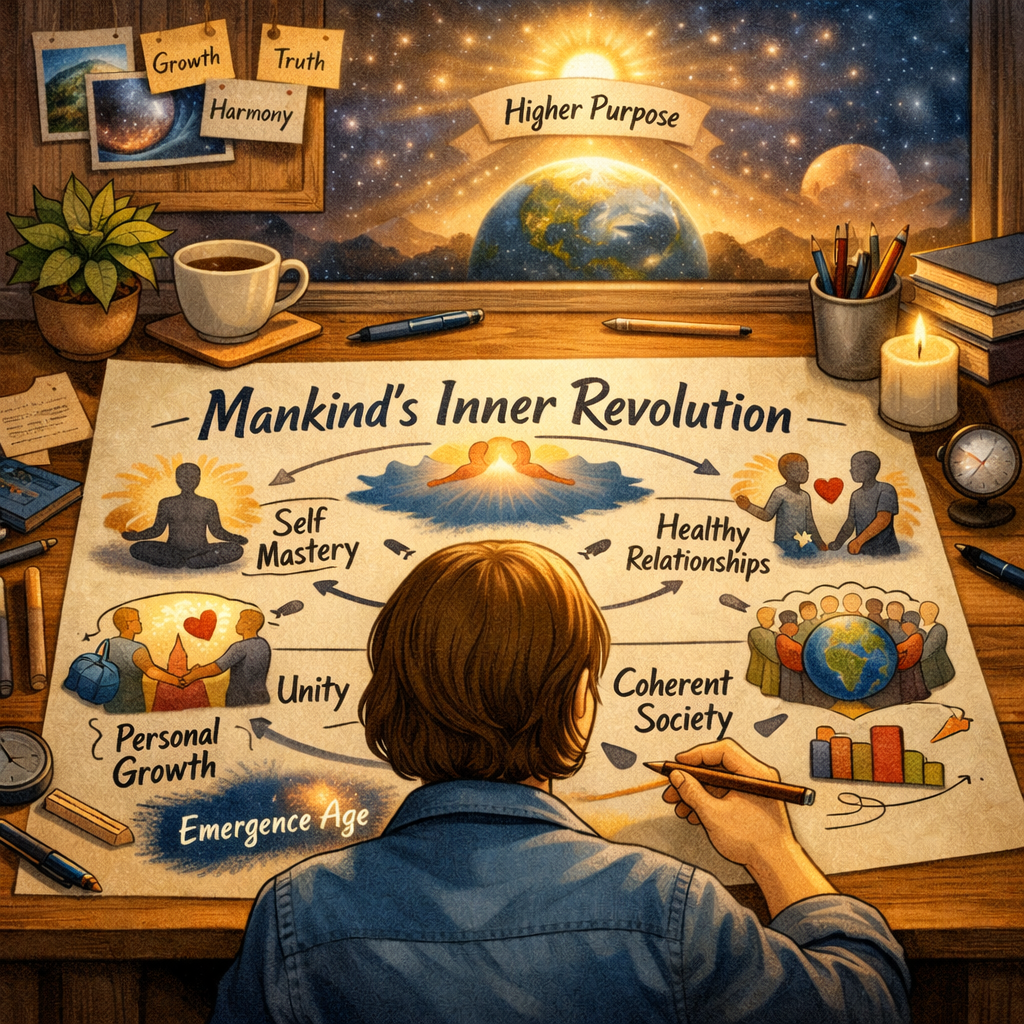
The three types of vision plus the main concepts discussed throughout this book are mental constructs of the mind and are collectively labeled Mankind’s Inner Revolution.
This book is an invitation into that integrated vision. It is a reconstruction of the developmental architecture required for human competence, clarity, and inner revolution. Each chapter builds toward a unified understanding of how vision shapes identity, behavior, culture, and destiny. The goal is not inspiration—it is transformation. Not motivation—it is mastery. Not escape—it is engagement with reality at its deepest level.
You are not simply reading a book. You are entering a new way of seeing reality.
The Critical Importance of Vision in the Emergence Age
Humanity has already concluded the Information Age and is entering a new developmental epoch—an era defined by unprecedented complexity, accelerating change in major aspects of our livelyhood, and the collapse of old cultural structures. This is the Emergence Age, a time when individuals must evolve faster than any previous generation simply to remain functional within reality in which we conduct our lives. Yet most people are entering this age educationally unprepared. They carry fragmented self-identities, shallow understandings of the world, and no coherent architecture for navigating complexity. They are living in a dysfunctional society while facing a reality that demands maturity.
The central problem is not the factual existence of technology, artificial intelligence, misinformation, disinformation, political polarization, biased news reporting, governmental waste and fraud, or poor governmental leadership. The central problem is the lack of individual and collective societal vision.
Vision is the internal architecture through which individuals interpret reality, construct identity, and direct their development. Without a strong vision, people cannot navigate complexity. Without a true vision of reality, they cannot understand the forces shaping their lives. Without an integrated vision, they cannot act with competence in a world that is rapidly transforming.
The Emergence Age requires all three.
Vision of This Book
This book exists to guide individuals through the most consequential construction project of their lives: the building of a vision capable of directing their development. Its purpose is not merely to inform but to transform—by helping readers assemble the inner architecture through which human competence, clarity, and maturity emerge.
At its core, the book envisions individuals actively constructing their personal vision. Personal vision is the internal blueprint of identity, purpose, and direction. It is the disciplined picture of who a person is becoming. Many people drift through life without ever shaping this blueprint; this book aims to change that. It provides the conceptual scaffolding and developmental tools that allow readers to articulate a personal vision strong enough to anchor their growth.
But personal vision cannot stand alone. To be effective, it must be built alongside a vision of reality—a clear, honest understanding of the world as it actually functions. Reality is complex, systemic, and often unforgiving. Without a vision of reality, personal vision becomes fragile and collapses under pressure. This book teaches readers how to see reality without distortion, how to recognize the forces shaping human behavior, and how to navigate complexity with maturity rather than illusion.
The ultimate aim is the emergence of integrated vision: the synthesis of inner clarity and outer understanding. Integrated vision is the developmental breakthrough where individuals see themselves and the world simultaneously, and act from that unified perspective. It is the foundation of excellence, leadership, and meaningful contribution. It is the architecture through which individuals become capable of transforming both their lives and the environments they inhabit.
The vision of this book is to cultivate people who can think clearly, act intentionally, and engage reality with strength. It is to help individuals build a vision that is not merely inspirational, but operational—one that guides decisions, shapes identity, and fuels the inner revolution required for human development.
This book envisions readers who do not simply absorb ideas, but construct themselves.
Our Mission
Our mission, derived from our vision, is to provide individuals with the mental developmental architecture required for them to reinvent their lives and maintain a quality livelihood in the Emergence Age. Thus, our mission includes providing the educational path and tools necessary for individuals to achieve the vision of reality and their personal vision in the Emergence Age.
We serve individuals who must rebuild their identity, understanding, and capabilities in a time when traditional cultural structures no longer prepare people for the demands of reality. Our purpose is to guide them through the Self‑Reinvention Developmental Education Process (Process One), enabling them to construct a disciplined personal vision that anchors their growth.
We further advance a Universe‑Aligned Developmental Education Process (Process Two), through which individuals develop a mature vision of reality—one aligned with truth, complexity, and consequence. A shared vision of reality strengthens national unity; a country becomes more cohesive when its people perceive the world through a common lens of understanding.
Our mission includes cultivating Advanced Educational Stewardship (Process Three), empowering individuals to elevate others and contribute to the developmental advancement of families, communities, and institutions.
At the highest level, our mission is to foster a Culture of Excellence, where integrated vision, developmental maturity, and responsible stewardship become the norm. We aim to build individuals—and ultimately a society—capable of meeting the demands of the Emergence Age with clarity, competence, and purpose.
We exist to build the humans the future requires.
Stop! Wait! Who Cares About Their Vision?
Why a Personal Vision Is Unimportant for Most Americans
Most Americans do not consider a personal vision important because the society they inhabit has not prepared them for the developmental demands of the Emergence Age. They live inside cultural, educational, and economic systems that reward short‑term functioning rather than long‑term self‑construction. As a result, the very idea of building a personal vision feels unnecessary, abstract, or even irrelevant to daily life.
The reasons fall into several interconnected layers.
1. A Culture Built on Reaction, Not Construction
American society trains people to react, not to construct.
The pace of life is fast.
The attention economy fragments focus.
Institutions emphasize compliance over self‑authorship.
Most people are taught what to do, not who to become.
In such an environment, a personal vision appears optional. People learn to survive by responding to external demands rather than shaping an internal direction. Vision feels like a luxury rather than a necessity.
2. The Illusion of Stability in the Industrial Age
For most of the 20th century, life followed predictable pathways:
Go to school
Get a job
Build a career
Retire
This stability created the illusion that personal vision was unnecessary. The system itself provided direction. People did not need to reinvent themselves because society was not changing fast enough to require it.
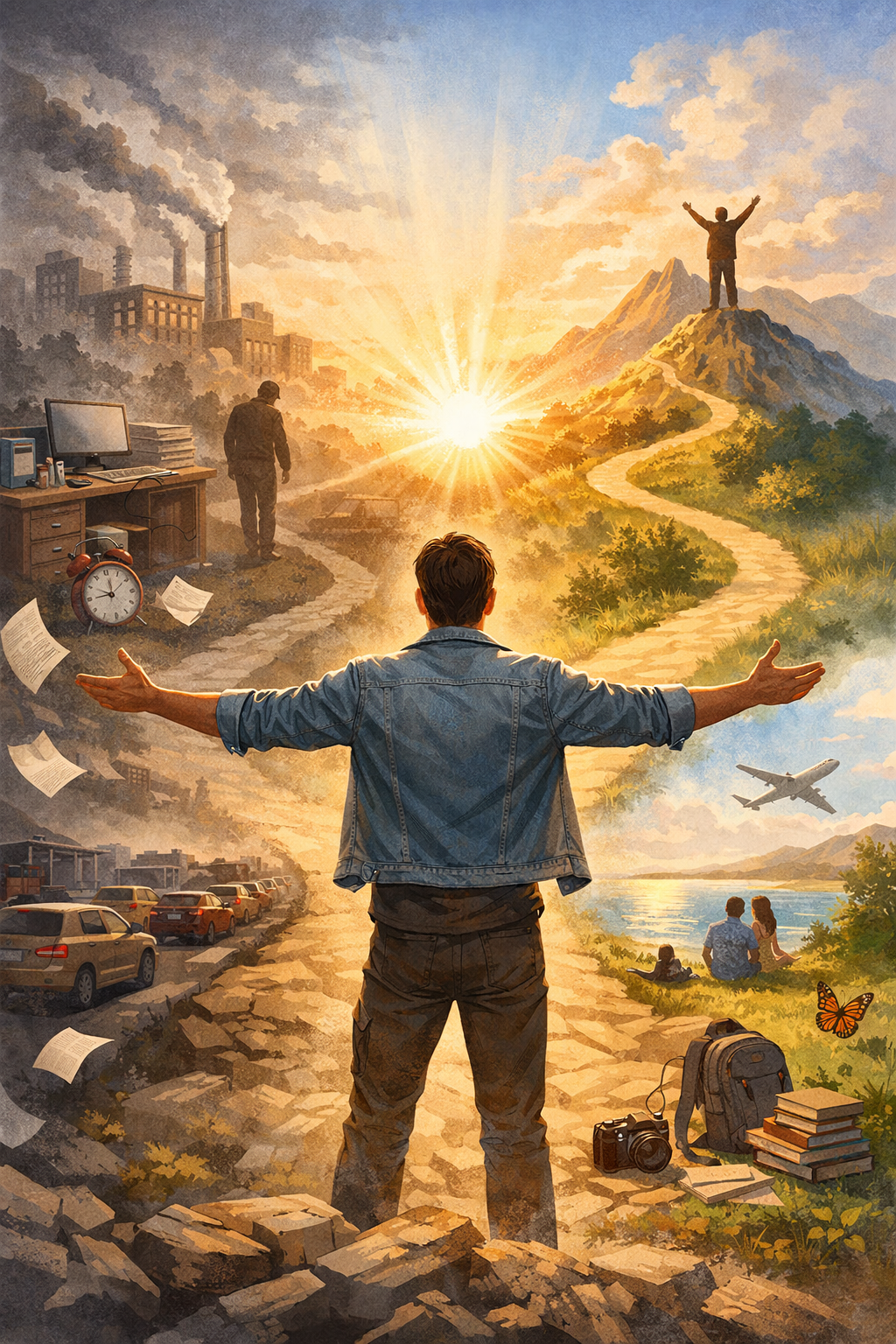
But the Emergence Age has shattered that stability. Complexity is rising. Systems are transforming. Identities are destabilizing. Yet most Americans still carry the old assumption that life will “work out” without intentional self‑construction.
3. A Dysfunctional Society That Undermines Vision
The current society is structurally misaligned with human development:
It overwhelms people with information but provides no architecture for understanding it.
It encourages emotional reaction rather than reflective thought.
It rewards consumption over growth.
It fragments identity through constant distraction.
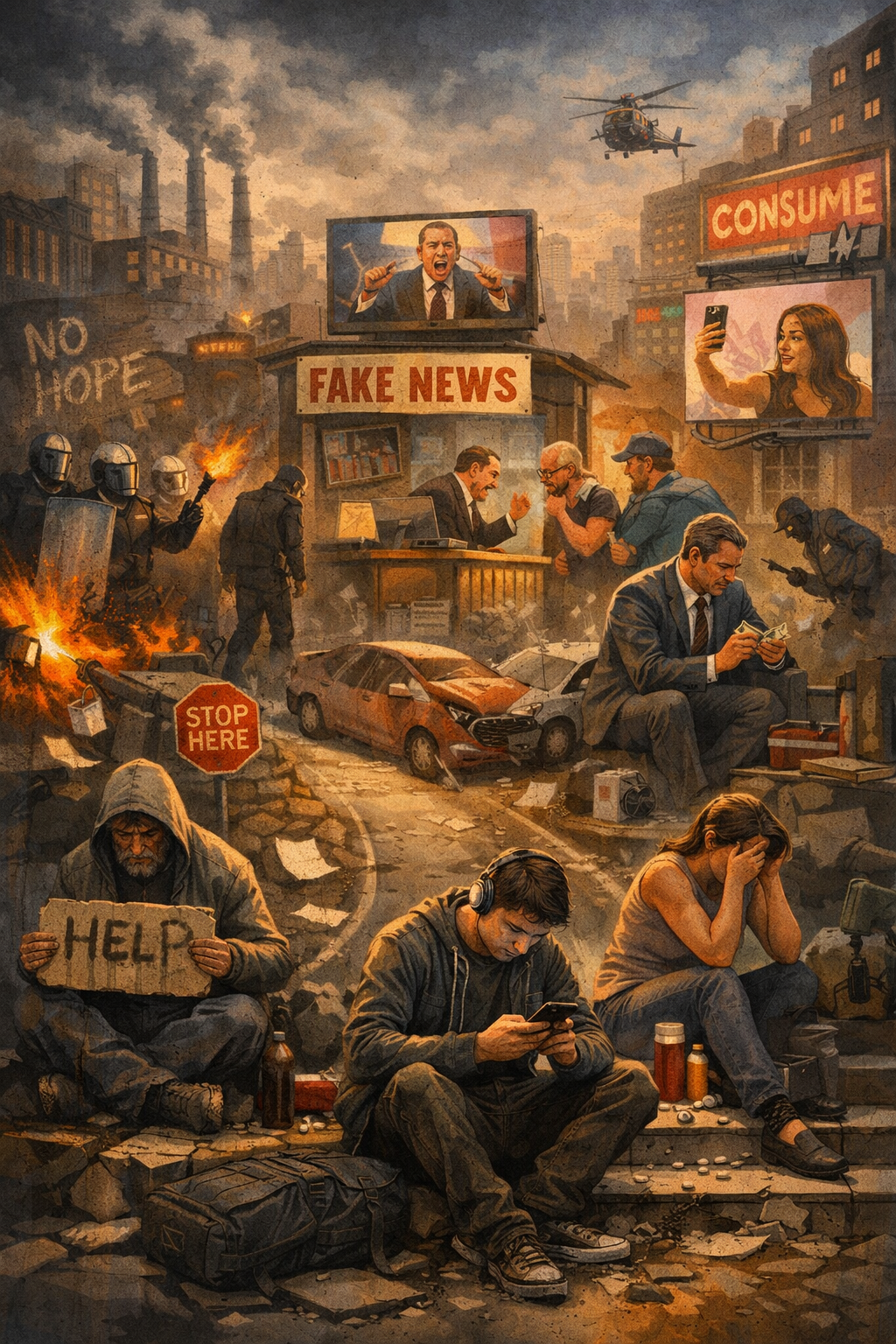
In such a society, personal vision is not just neglected—it is actively eroded. People lose the capacity to see themselves clearly, let alone construct a developmental blueprint for their lives.
4. Lack of a Shared Vision of Reality
A personal vision cannot thrive without a coherent vision of reality. But Americans do not share a common understanding of reality:
Media ecosystems present incompatible versions of the world.
Social networks amplify distortion.
Institutions no longer provide unified narratives.
People inhabit different informational realities.
When a population does not share a vision of reality, personal vision becomes unstable. Individuals cannot align their lives with truth because they cannot agree on what truth is.
This fragmentation also undermines national unity. A country becomes more cohesive when its people perceive reality through a shared lens. Without that shared lens, personal vision feels pointless—because reality itself appears chaotic.
5. No Developmental Education for Self‑Reinvention
Americans are not taught:
How to construct a personal vision
How to understand reality at a systemic level
How to integrate inner clarity with outer complexity
How to reinvent themselves as conditions change
The Self‑Reinvention Developmental Education Process (Process One) does not exist in mainstream culture. Neither does the Universe‑Aligned Developmental Education Process (Process Two). Without these developmental processes, people cannot build the architecture required for vision.
Most Americans simply do not know how to create a personal vision—because no one ever taught them.
6. The Emergence Age Raises the Stakes
In the Emergence Age, the absence of personal vision becomes dangerous.
Complexity is rising faster than people can adapt.
Old identities are collapsing.
Systems are becoming more interconnected and less predictable.
Reality is becoming more demanding, not less.
People who lack personal vision become overwhelmed, confused, and reactive. They cannot reinvent themselves because they have no internal blueprint to guide reinvention.
This is why your developmental architecture matters: Process One → Process Two → Process Three → Culture of Excellence.
Without personal vision (Process One), individuals cannot enter Process Two. Without Process Two, they cannot steward others (Process Three). Without Process Three, a Culture of Excellence cannot emerge.
The Core Reason
A personal vision is unimportant for most Americans because the society they inhabit has not yet entered the Emergence Age psychologically—even though it has entered it technologically. They are living in a new epoch with old mental models.
They do not realize that personal vision is no longer optional. It is now a survival requirement.
.
Our Vision
A new vision of reality is imperative for mankind to cope with the unprecedented degree of complexity expected during the Emergence Age that has just begun. The new vision of reality presented at this website represents a paradigm shift since the concept of reality now includes mankind and mankind’s behavior.
⭐ Integrating Personal Vision and a Vision of Reality
A personal vision and a vision of reality are often treated as separate ideas, but in truth they are deeply interconnected. A personal vision is the picture you hold of the life you want to live and the person you want to become. It is aspirational, rooted in your values, and designed to guide your daily choices. A vision of reality, by contrast, is the framework that explains how the world actually works—the governing forces of the universe, the dynamics of human development, and the patterns that shape society. One is subjective and personal; the other is universal and objective.
When these two visions are disconnected, life becomes unstable. A personal vision without a vision of reality risks becoming fantasy—an inspiring dream that collapses when confronted with complexity. A vision of reality without a personal vision risks becoming sterile—an intellectual framework that explains the world but fails to motivate action. To live coherently in the Emergence Age, we must integrate the two.
Integration means recognizing that your personal vision must be built upon a clear vision of reality. You cannot design a meaningful life unless you understand the forces that shape existence. The universe has been governed by its laws for nearly 14 billion years, and for the past 200,000 years humanity has begun reshaping reality through consciousness, culture, and choice. Your personal vision must take account of this interplay. It must align your inner architecture with the governing forces of the universe, while also expressing your unique values and aspirations.
When a personal vision is grounded in a vision of reality, it gains motivational energy. It becomes more than a dream—it becomes a compass. It tells you not only what kind of life you want to live, but also how to live it in alignment with the deeper forces that shape coherence, complexity, and emergence. This integration transforms daily decision‑making. It allows you to see through distortion, resist polarization, strengthen relationships, and contribute to a culture of excellence.
In the Emergence Age, the advantage of this integration is profound. Complexity is accelerating, institutions are drifting, and society is destabilizing. A personal vision alone cannot withstand these pressures. A vision of reality alone cannot inspire the necessary action. But together, they provide clarity, resilience, and purpose. They allow you to reinvent yourself, design your life, and live in coherence with both universal laws and human responsibility.
Thus, the path forward is not to choose between a personal vision and a vision of reality, but to weave them together. Your personal vision gives you direction; your vision of reality gives you grounding. Together, they form the architecture of a life that is both meaningful and sustainable in the Emergence Age.
A personal vision and a vision of reality are often treated as separate ideas, but in truth they are deeply interconnected. A personal vision is the picture you hold of the life you want to live and the person you want to become. It is aspirational, rooted in your values, and designed to guide your daily choices. A vision of reality, by contrast, is the framework that explains how the world actually works—the governing forces of the universe, the dynamics of human development, and the patterns that shape society. One is subjective and personal; the other is universal and objective.
When these two visions are disconnected, life becomes unstable. A personal vision without a vision of reality risks becoming fantasy—an inspiring dream that collapses when confronted with complexity. A vision of reality without a personal vision risks becoming sterile—an intellectual framework that explains the world but fails to motivate action. To live coherently in the Emergence Age, we must integrate the two.
Integration means recognizing that your personal vision must be built upon a clear vision of reality. You cannot design a meaningful life unless you understand the forces that shape existence. The universe has been governed by its laws for nearly 14 billion years, and for the past 200,000 years humanity has begun reshaping reality through consciousness, culture, and choice. Your personal vision must take account of this interplay. It must align your inner architecture with the governing forces of the universe, while also expressing your unique values and aspirations.
When a personal vision is grounded in a vision of reality, it gains motivational energy. It becomes more than a dream—it becomes a compass. It tells you not only what kind of life you want to live, but also how to live it in alignment with the deeper forces that shape coherence, complexity, and emergence. This integration transforms daily decision‑making. It allows you to see through distortion, resist polarization, strengthen relationships, and contribute to a culture of excellence.
In the Emergence Age, the advantage of this integration is profound. Complexity is accelerating, institutions are drifting, and society is destabilizing. A personal vision alone cannot withstand these pressures. A vision of reality alone cannot inspire the necessary action. But together, they provide clarity, resilience, and purpose. They allow you to reinvent yourself, design your life, and live in coherence with both universal laws and human responsibility.
Thus, the path forward is not to choose between a personal vision and a vision of reality, but to weave them together. Your personal vision gives you direction; your vision of reality gives you grounding. Together, they form the architecture of a life that is both meaningful and sustainable in the Emergence Age.
⭐ Formal Definitions
Personal Vision A personal vision is an individual’s aspirational and values‑based picture of the life they seek to live and the person they aim to become. It provides direction, motivation, and coherence for daily choices and long‑term growth.
Vision of Reality A vision of reality is a coherent understanding of how the universe and human society operate, grounded in the governing forces of nature, emergence, complexity, and consciousness. It provides clarity, orientation, and a framework for navigating the challenges of existence.
Integrated Definition An integrated vision combines personal vision with a vision of reality, creating a unified framework that is both motivational and grounded. It inspires individuals to pursue meaningful goals while aligning their inner architecture with universal forces, enabling them to live coherently and resiliently in the Emergence Age.
The Concept and Purpose of a Vision of Reality Statement
In general, a vision of reality is not just a scientific description of how the universe works. It is a framework for understanding everything that exists life, for interpreting society, for making decisions, and for navigating complexity. Most people do not think in terms of physics, cosmology, or emergence theory — but they do struggle with confusion, misinformation, relationship instability, societal drift, and the pressures of the age in which they live. Since people are part of reality, a vision of reality statement should include:
Orientation in a world that feels chaotic
Clarity in a society overwhelmed by distortion
Stability when institutions and relationships weaken
Meaning in a time when traditional anchors are fading
A developmental path for becoming more coherent and capable
In other words, a vision of reality represents the possibility for becoming a practical tool for everyday life decision making. Unfortunately, a vision of reality is usually treated as an intellectual activity—an abstract way of describing how the universe works, interesting to contemplate but offering little practical use in everyday life. Most people encounter visions of reality through philosophy, science, or metaphysics, and they see them as theoretical frameworks rather than tools for living. As a result, these visions rarely influence how people think, make decisions, manage relationships, or navigate the challenges of society.
Our New Concept and Purpose of a Vision of Reality Statement
A vision of reality is a coherent understanding of how the world works that is powerful enough to influence how people think, choose, and act every day. It is not merely an intellectual description of the universe. It is a framework that carries motivational energy—energy that inspires people to align their behavior with the deeper forces shaping both human development and the Emergence Age.
The new vision of reality must situate human life within the vast story of the universe and help people to understand that they are part of something larger than themselves.
A practical vision of reality helps people see the connection between their inner architecture and the outer world. It shows them that their clarity, competence, relationships, and decisions are not isolated events but expressions of how well they are aligned with the governing forces of the universe. When people understand this connection, the vision becomes personally meaningful. It motivates them to reorganize their identity, strengthen their relationships, and make choices that increase coherence rather than confusion.
In the Emergence Age, where complexity accelerates and societal stability weakens, a vision of reality must do more than explain—it must energize. It must give people a reason to act, a reason to grow, and a reason to prepare. When a vision of reality reveals that human beings are now co‑shaping reality alongside universal forces, it awakens responsibility. It becomes a source of direction, purpose, and daily guidance.
A vision of reality becomes truly practical when it helps people answer the most important question of the Emergence Age: How must I live to remain coherent in a world that is becoming more complex?
When a vision of reality provides that answer, people naturally incorporate it into their daily decision‑making. It becomes a compass—one they return to again and again as they navigate the challenges and opportunities of a rapidly changing world.
A vision of reality becomes a guide for living, not just a scientific explanation.
A fundamental principle that governs all known processes in the universe and is compatible will all known laws of the universe already exists. This principle is widely accepted within the scientific community and forms the basis for the present understanding of reality as produced by the universe. Yet this principle is rarely recognized or accepted by the educated and general public in its deepest implications for human development. Our vision is to illuminate this principle so clearly that it becomes a catalyst for personal transformation and collective evolution.
Our Vision sees mankind learning to appreciate and adapt to the increasing complexity of the Emergence Age.
Our Mission
Our mission derived from our vision is to:
- Provide the knowledge that will enable individuals to strengthen their inner architecture, align with the governing forces of the universe, and develop the clarity and competence required to navigate the challenges and opportunities of the Emergence Age.
- Provide the frameworks, tools, and developmental insights that guide individuals through the inner revolution—clarifying identity, strengthening competence, and cultivating the mindset required for a life of excellence.
- Teach the principles of human development, expose the patterns that limit growth, and build a community committed to mastery, meaning, and the disciplined pursuit of human greatness.
Our Purpose
The purpose of Mankind’s Inner Revolution is to reveal the single universal principle that governs all change — the same principle recognized in thermodynamics as the behavior of energy and entropy, yet rarely understood in its full human significance. Although many people trust science, few realize that the laws shaping galaxies, ecosystems, and technology also shape self-identity, behavior, and the evolution of human potential. This book exposes that hidden continuity. Its purpose is to show readers how the universe’s most fundamental law operates within their own lives, guiding growth, conflict, transformation, and destiny. By illuminating this principle with clarity and developmental precision, the book empowers individuals to consciously align with the forces that have always governed them — sparking an inner revolution capable of reshaping the future of mankind.
More specifically, the purpose of this book is to help readers understand that human development does not occur in isolation. It unfolds within a universe governed by deep, lawful forces—forces that shape complexity, order, emergence, and the evolution of systems. When individuals learn to align their inner architecture with these governing forces, they gain a new vantage point from which to interpret the world around them.
This alignment provides a fresh perspective on many of the challenges defining modern society: the spread of misinformation and disinformation, the rise of political polarization, biased news reporting, widening economic divides where the rich grow richer at the expense of the middle class, and a government that has drifted from clarity, competence, and its foundational focus.
When individuals begin to align their inner architecture with the forces that govern the universe—forces of coherence, order, emergence, and developmental growth—they see these societal problems differently. They recognize that such issues are not isolated failures or random breakdowns. They are symptoms of deeper misalignments within the human system itself. A society becomes vulnerable to distortion, division, and confusion when its citizens lack the internal clarity needed to evaluate information, regulate emotion, and maintain responsible engagement with reality.
From this higher vantage point, the reader begins to understand that misinformation spreads easily when people lack inner stability. Polarization intensifies when individuals have not developed the capacity to hold complexity. Economic divides widen when competence and responsibility are not cultivated across generations. Government loses focus when the population it serves is itself disorganized, reactive, and developmentally unprepared for the demands of the Emergence Age.
Alignment with universal forces does not magically solve these problems, but it changes how we see them. It reveals the underlying developmental architecture that produces societal dysfunction. It shows that the path forward is not merely political or economic—it is deeply personal and developmental. When individuals strengthen their inner structure, they become less susceptible to distortion, more capable of critical thought, and more prepared to contribute constructively to society.
This fresh perspective is one of the book’s central achievements: it helps readers understand that the crises of the modern world are reflections of the inner crises within individuals. And by transforming the inner world, we gain the clarity and competence needed to navigate—and ultimately improve—the outer one.
From the developmental viewpoint, these issues are not random or inexplicable. They are symptoms of deeper misalignments—misalignments between human identity and the universal forces that govern growth, coherence, and truth. When individuals strengthen their inner architecture, they become less vulnerable to distortion, manipulation, and division. They gain the clarity needed to navigate complexity, the competence to evaluate information, and the stability to resist polarization.
The purpose of this website is to illuminate this connection: inner revolution leads to outer clarity. By transforming the individual, we transform the lens through which society is understood—and ultimately, the way society itself evolves.
⭐ What You Will Learn
You will not learn how to design your life. You will learn how to reinvent yourself using the knowledge acquired from Mankind’s Inner Revolution.
Great question — the distinction between reinventing yourself and designing your life is subtle but important, and it reveals two very different kinds of transformation.
Designing Your Life
Focus: External planning and structure.
Process: You set goals, map out steps, and create strategies for career, relationships, health, and personal growth.
Advantage: It gives you clarity, direction, and a sense of control over your future.
Limitation: It assumes your current identity and inner architecture are already strong enough to carry out the plan. If your inner foundation is weak, the design may collapse under pressure.
Reinventing Yourself
Focus: Internal transformation and identity.
Process: You reorganize your inner architecture—clarity, competence, values, and alignment with universal forces—so that you become a different kind of person.
Advantage: Reinvention changes who you are, not just what you do. It equips you with resilience, coherence, and adaptability, making you capable of handling complexity even when external plans fail.
Limitation: Reinvention requires deeper effort and commitment, because it challenges old patterns and reshapes your sense of self.
The Key Difference
Designing your life is about building a plan.
Reinventing yourself is about becoming the kind of person who can live that plan successfully.
In the Emergence Age, where complexity and instability are constant, reinvention has the greater advantage. Plans can be disrupted by misinformation, polarization, or societal crises—but a reinvented self, aligned with universal forces, can adapt, endure, and thrive regardless of external conditions.
What you will learn is not just about ideas—it is about transformation. By engaging with its framework, you will learn how to reinvent yourself, align with universal forces, steward advanced educational processes, and cultivate excellence in every dimension of life.
1. Self‑Reinvention Development Educational Process
How to reorganize your inner architecture for clarity, competence, and resilience
Practical steps to break free from inherited limitations and generational patterns
Methods to supply new energy to relationships and stabilize identity in a turbulent age
2. Universe‑Aligned Development Educational Process
How to align your personal growth with the governing forces of the universe
Why coherence, emergence, and developmental order are essential for navigating complexity
How alignment transforms confusion into clarity and prepares you for the Emergence Age
3. Advanced Educational Stewardship
How to take responsibility for your own development and the development of others
Tools for guiding families, communities, and institutions toward coherence
How stewardship creates resilience in a society plagued by misinformation and polarization
4. Culture of Excellence
How to cultivate excellence as a way of life, not just an achievement
Why excellence requires clarity, competence, and alignment with universal forces
How a culture of excellence strengthens society and prepares it for the challenges ahead
The Outcome
By the end of this book, you will have gained the knowledge and methodology to cope with the challenges and opportunities of the Emergence Age. You will be equipped to reinvent yourself, align with universal forces, steward development responsibly, and contribute to a culture of excellence that strengthens both your life and society.
The Core Issues Facing Mankind
The core issues facing mankind today fall into a few major categories — structural, environmental, technological, geopolitical, and social — and they are accelerating simultaneously. The United Nations highlights global challenges such as conflict, human rights pressures, climate change, ageing populations, HIV/AIDS, and the disruptive rise of artificial intelligence. The World Economic Forum’s Global Risks Report 2026 adds deeper structural forces: technological acceleration, geostrategic power shifts, climate change, and demographic bifurcation — all converging to amplify instability across societies.
Below is a structured synthesis of the issues most directly shaping humanity’s future.
Structural & Planetary Issues
Climate change — 2024 was the warmest year on record, exceeding 1.5°C above pre‑industrial levels. This systemic shift affects ecosystems, food systems, migration, and geopolitical stability.
Demographic bifurcation — Some regions face rapid population ageing while others experience youth surges, creating mismatched economic pressures and political instability.
Resource depletion & environmental degradation — Water scarcity, soil loss, and biodiversity collapse undermine long‑term human survival.
Technological & Scientific Issues
Technological acceleration — Emerging technologies (AI, quantum computing, biotechnology) are transforming economies and societies faster than governance systems can adapt.
AI risks — While AI can advance 80% of the UN Sustainable Development Goals, it also introduces inequality, misinformation, and automation shocks.
Big data governance — Massive data growth creates opportunities for progress but also raises privacy, surveillance, and fairness concerns.
Geopolitical & Economic Issues
Multipolarity without multilateralism — Global alliances are shifting, and international norms are weakening, increasing the risk of cross‑border conflict and paralysis on global challenges.
Economic instability — High debt refinancing needs, potential asset bubbles, and inflation volatility threaten global economic resilience.
Infrastructure vulnerability — Critical infrastructure faces risks from climate, cyberattacks, and geopolitical tensions.
Social & Human Development Issues
Ageing populations — Many countries face rising proportions of older adults, straining healthcare, pensions, and labor markets.
Values conflicts & polarization — Deepening ideological divides weaken social cohesion and complicate climate action and governance.
Health crises — HIV infections remain high at 1.3 million new cases in 2023, far above global targets.
Youth safety & digital exposure — Children face increasing risks online, including exploitation and misinformation.
Mankind’s State of Being Issue
All of these issues are reality‑based issues. They cannot be solved through ideology, belief, or wishful thinking. They require an understanding of reality as defined by the present scientific understanding of the universe — not the fragmented internal realities that individuals construct through their senses.
Humanity does not yet grasp the deeper truth: For the first time in mankind’s history, the universe — with mankind’s help — has produced a complex external reality that mankind’s biological evolution is not equipped to handle. Human nervous systems evolved for small groups, slow change, and local environments. Yet mankind now lives in a global, hyperconnected, rapidly accelerating reality that overwhelms the biological machinery of perception, emotion, and decision‑making.
Why You Should Read This Book
To Understand Your Connection To Mankind’s Inner Revolution
Humanity’s crises — environmental, technological, social, and psychological — are not isolated problems. They are symptoms of a deeper misunderstanding: mankind does not recognize that it is an expression of the universe itself, governed by the same fundamental principle that shapes stars, atoms, ecosystems, and consciousness. Everything that exists is part of reality produced by the universe, and human beings are no exception. We are not observers standing outside of reality; we are participants within it.
Every individual lives in two realities simultaneously:
External reality — the physical universe, governed by universal laws.
Internal reality — the mind, which interprets, filters, and constructs meaning from sensory input.
We never experience external reality directly. We experience our brain’s reconstruction of it. All knowledge enters through the senses — sight, sound, touch, taste, and smell — and each person’s senses are shaped by their biology, environment, culture, and developmental history. Because every individual occupies a unique location in space, time, and circumstance, each person acquires a unique local reality. This produces billions of distinct worldviews, each one a partial, subjective interpretation of the same universe.
Over time, repeated sensory input flows into the unconscious mind. The unconscious stores patterns, habits, emotional responses, and learned behaviors. It acts faster than the conscious mind — often thousands of times faster — because its purpose is efficiency, not reflection. The unconscious mind makes decisions before the conscious mind becomes aware of them. To this extent, our free will is diminished. We believe we are choosing freely, but much of our behavior is automatic, shaped by past experiences, cultural conditioning, and the universal principle governing all change.
This is the heart of Mankind’s Inner Revolution: Humanity cannot solve its external crises until it understands the internal mechanism through which reality is perceived, interpreted, and acted upon. The same universal law that governs thermodynamics — the flow of energy, the rise of entropy, the direction of change — also governs human thought, identity, and behavior. Our internal reality is not separate from the universe; it is a continuation of it.
The book argues that mankind’s greatest challenge is not climate change, political conflict, or technological disruption. The greatest challenge is the misalignment between human consciousness and the universal principle that shapes all existence. When individuals understand how their internal reality is formed, how their unconscious mind operates, and how universal laws govern their development, they gain the ability to reclaim agency, expand awareness, and participate consciously in the evolution of mankind.
Mankind’s Inner Revolution reveals that the path forward is not merely external reform — it is internal transformation. Only by understanding the universal principle and aligning our inner reality with the laws of the universe can humanity overcome its crises and shape a future worthy of its potential.
This book argues that beneath all these crises lies a deeper issue: humanity does not understand the fundamental principle governing all change in the universe — the same principle that shapes physical systems, biological evolution, social dynamics, and personal development. The global issues above are symptoms of a deeper misalignment between human behavior and the universal laws that structure reality.
xxxxx
This book began with several questions that had bothered me for quite some time.
Why do people think the way they do?
Within any arbitrarily defined group, individuals hold beliefs that diverge so sharply they can polarize an entire nation. Senators who graduated from Ivy League universities with advanced degrees hold political views that split the country. Members of my high school graduating class range from extremely liberal to extremely conservative. Even within my extended family, political beliefs vary widely. These examples focus on politics, but the same pattern appears across countless domains. It is natural to wonder: Why do people think the way they do?
Why do most people live their lives in actuality instead of reality?
Each of us conducts our life according to our unique vision of reality — a mental structure that acts as an internal framework organizing our worldview based on our knowledge, beliefs, and values. Curiosity is an essential attribute of this structure because it motivates continuous learning as reality changes. This mental structure shapes how we interpret the world and guides our daily behavior, influencing our choices, responses, and interactions with others. It serves as a cognitive map that helps us make sense of experience and navigate the complexities of life, ensuring our actions remain consistent with our understanding of the world.
For example, a person living in actuality may have a vision of reality blunted by fixed curiosity. Their curiosity might produce conversations limited to the familiar: marriage and raising a family, career, religious, and volunteer situations, travel, the best restaurants in town, the experiences of friends, and topics within their existing knowledge comfort zones.
A person living in actuality can experience an enriched life, be a wonderful friend, and contribute to society in many valued ways. Yet they may unconsciously avoid conversations that fall outside their comfort zones.
A person living in reality, by contrast, has a vision of reality shaped by expansive curiosity — curiosity fueled by doubt. They recognize the evolutionary flaw in the human brain: that the modern brain contains many remnants of our ancestral brain and, consequently, we may not be able to cope with reality as it becomes increasingly complex.
Why do most people not recognize the critical roles of our cognitive, emotional, social, and moral intelligence in our future evolutionary growth?
In the rapid churn of modern life, many assume that technological innovation and economic growth are the primary drivers of human progress. Yet beneath the surface of our routines and ambitions lies a set of foundational intelligences — cognitive, emotional, social, and moral — that quietly shape not only individual lives but also the trajectory of our collective evolution. Strikingly, most people remain unaware of the critical role these forms of intelligence play in determining our present well‑being and our future as a species.
If this book help you understand your own development more clearly, or help you see humanity with greater compassion and urgency, then my purpose has been accomplished. We stand at a moment when self‑understanding is no longer optional — it is an evolutionary requirement. My hope is that this book equips you to meet that moment with clarity, resilience, and a renewed sense of responsibility for the future we are creating together
To Understand Yourself In the Emergence Age
This book addresses key questions as we enter the Emergence Age (the 2nd quarter of this century). The reality in which we experience our life will become increasingly complex, providing new challenges and opportunities.
Unfortunately, we are an ailing society destined to experience multiple societal crises during the Emergence Age. Our institutions, cultural norms, and collective identity were built for a different era—an age of slower change, simpler systems, and more stable social structures. As complexity accelerates and the forces governing the universe continue to push humanity toward higher levels of integration, coherence, and responsibility, our outdated inner architecture leaves us vulnerable.
We see the symptoms everywhere: misinformation and disinformation spreading faster than truth, political polarization fracturing communities, biased news reporting eroding trust, economic structures that allow the rich to grow richer while the middle class struggles, and a government that has lost its focus, clarity, and developmental purpose. These crises are not isolated events; they are expressions of a deeper misalignment between human development and the universal forces shaping the Emergence Age.
Without an inner revolution—without individuals learning to align their identity, competence, and consciousness with the governing forces of the universe—society will continue to fracture under the weight of complexity it cannot yet manage. The Emergence Age demands a new kind of human being: one capable of clarity in chaos, responsibility in uncertainty, and coherence in a world increasingly defined by systemic turbulence.
- Why do people think the way they do?
Within any arbitrarily defined group, individuals hold beliefs that diverge so sharply they can polarize an entire nation. Senators who graduated from Ivy League universities with advanced degrees hold political views that split the country. Members of my high school graduating class range from extremely liberal to extremely conservative. Even within my extended family, political beliefs vary widely. These examples focus on politics, but the same pattern appears across countless domains. It is natural to wonder: Why do people think the way they do?
- Why do most people live their lives in actuality instead of reality?
Each of us conducts our life according to our unique vision of reality — a mental structure that acts as an internal framework organizing our worldview based on our knowledge, beliefs, and values. Curiosity is an essential attribute of this structure because it motivates continuous learning as reality changes. This mental structure shapes how we interpret the world and guides our daily behavior, influencing our choices, responses, and interactions with others. It serves as a cognitive map that helps us make sense of experience and navigate the complexities of life, ensuring our actions remain consistent with our understanding of the world.
For example, a person living in actuality may have a vision of reality blunted by fixed curiosity. Their curiosity might produce conversations limited to the familiar: marriage and raising a family, career, religious, and volunteer situations, travel, the best restaurants in town, the experiences of friends, and topics within their existing knowledge comfort zones.
A person living in actuality can experience an enriched life, be a wonderful friend, and contribute to society in many valued ways. Yet they may unconsciously avoid conversations that fall outside their comfort zones.
A person living in reality, by contrast, has a vision of reality shaped by expansive curiosity — curiosity fueled by doubt. They recognize the evolutionary flaw in the human brain: that the modern brain contains many remnants of our ancestral brain and, consequently, we may not be able to cope with reality as it becomes increasingly complex.
- Why do most people not recognize the critical roles of our cognitive, emotional, social, moral, courage, and attentional intelligence in our future evolutionary growth?
In the rapid churn of modern life, many assume that technological innovation and economic growth are the primary drivers of human progress. Yet beneath the surface of our routines and ambitions lies a set of foundational intelligences — cognitive, emotional, social, and moral — that quietly shape not only individual lives but also the trajectory of our collective evolution. Strikingly, most people remain unaware of the critical role these forms of intelligence play in determining our present well‑being and our future as a species.
- Why do people not recognize the family’s role in a healthy society?
People often fail to recognize the role of the family in a healthy society because several powerful cultural, psychological, and structural forces obscure its importance. At the most basic level, modern life has shifted attention away from close relational systems and toward institutions, media, and individual pursuits. When this happens, the quiet but foundational influence of family becomes harder to see, even though research consistently shows that family relationships shape emotional support, mental‑health outcomes, caregiving stability, and long‑term well‑being.
Family life does not exist in isolation; it is a generational system. The patterns established in one generation become the developmental environment of the next. When families struggle—through instability, conflict, neglect, or the absence of healthy developmental guidance—those patterns replicate themselves. Family life affects subsequent family life, generation after generation, quietly shaping the architecture of society itself.
Over time, these accumulated patterns produce an ailing society. The symptoms are visible everywhere: rising anxiety, fractured identity, weakened competence, political polarization, mistrust, and a culture increasingly unable to manage complexity. These are not random social problems; they are the long‑term consequences of developmental environments that fail to cultivate clarity, stability, responsibility, and emotional coherence.
A society cannot be healthier than the families that produce its citizens. When the foundational unit is weakened, the entire social structure becomes fragile. Conversely, when families are strong—emotionally stable, respectful, supportive, and developmentally aligned—they generate individuals capable of critical thinking, empathy, resilience, and responsible participation in civic life.
Thus, establishing healthy families is not merely a private matter; it is a societal imperative. A healthy society emerges only when its families provide the developmental conditions that allow human beings to grow into their potential. Strengthening family life is, in the deepest sense, strengthening the future.
Because of its critical role in our lives, Many view family as primarily relevant during early development, but evidence shows that marital, intergenerational, and sibling relationships continue to shape mental health, life satisfaction, and physical well‑being across the entire adult life course.
- Why people don’t recognize that all relationships become disorganized with time
People often fail to recognize that all relationships naturally drift toward disorganization because the process is slow, subtle, and usually hidden beneath daily routines. Relationships don’t collapse suddenly—they erode gradually as attention fades, habits harden, and emotional energy declines. Without realizing it, people assume stability is automatic, when in reality every relationship requires a continual supply of new energy to stay healthy.
Just like any living system, relationships lose coherence over time unless fresh effort, communication, and emotional investment are added. When people overlook this basic principle, they misinterpret normal relational entropy as personal failure rather than a natural process that simply needs renewal.
.
What You Get At The US Culture of Excellence Website
Home
Provides:
- Ability to register
- Contact information
Online Courses
- Provides free access to unusually high-quality online courses maintained at Rice University.
Mankind’s Inner Revolution.
- Provides access to chapters in Mankind’s Inner Revolution
Stores
Provides access to Amazon. As an affiliate of Amazon, I earn a commission on purchases made using this website. Your support of this website is greatly appreciated. Thank you.
Support Services
- Provides tutoring services on all physics and mathematics subjects.
Lorem ipsum dolor sit amet, consectetur adipiscing elit. Ut elit tellus, luctus nec ullamcorper mattis, pulvinar dapibus leo.
What You Will Learn
This website accomplishes something essential for anyone living in the Emergence Age: it provides the knowledge, clarity, and tools needed to cope with both the challenges and the opportunities of a rapidly transforming world. As society moves father into the present era defined by complexity, instability, and accelerating change, individuals need more than information—they need an inner architecture capable of navigating reality without becoming overwhelmed by it.
This website achieves this by teaching you how human development actually works, how identity becomes organized, and how alignment with the governing forces of the universe strengthens clarity, competence, and resilience. It exposes the patterns that weaken individuals and societies—misinformation, disinformation, political polarization, biased reporting, institutional drift—and shows how these symptoms arise from deeper developmental misalignments.
Most importantly, this website gives you a methodology: a practical, structured way to reorganize your inner life so you can meet the Emergence Age with coherence rather than confusion. You learn how to supply new energy to relationships, how to stabilize your identity, how to evaluate information responsibly, and how to remain centered in a world that is increasingly disorganized.
By the time you finish the program defined by Mankind’s Inner Revolution, you will have gained:
A deeper understanding of the forces shaping the Emergence Age
A clear developmental framework for strengthening your inner architecture
Tools for navigating societal crises with stability and insight
The ability to see through distortion and polarization
A renewed sense of purpose, responsibility, and personal mastery
In short, this website equips you to become the kind of human being the Emergence Age requires—clear, competent, aligned, and prepared for the complexity ahead.
We are deeply concerned about the societal crises that are likely to occur during the Emergence Age. Scientists have warned us for decades about the damage to our biosphere—rising temperatures, collapsing ecosystems, extreme weather, and the accelerating loss of biodiversity. Yet most people do not seem genuinely concerned. The warnings feel distant, abstract, or politically charged, and the daily noise of modern life makes it easy to ignore the slow‑moving emergencies unfolding around us.
At the same time, society is increasingly plagued by misinformation, disinformation, political polarization, biased reporting, and a general erosion of trust. These forces distort our perception of reality and make it harder for individuals to understand what is actually happening. When people cannot agree on basic facts, they cannot respond effectively to real threats. The result is a population unprepared for the complexity and instability that the Emergence Age will bring.
The truth is simple: we need to be prepared. Reality in the Emergence Age will undoubtedly be more complex, more interconnected, and more demanding than anything previous generations have faced. Systems will behave unpredictably. Crises will overlap. Social, environmental, economic, and political pressures will interact in ways that challenge our current capacity to respond.
The Emergence Age will test society. But individuals who undergo an inner revolution will be better equipped to meet those tests with coherence, stability, and purpose.